

On Nonsense
The point is a circle, with many points, forming a rose, to make a point

This is my last post and parting gift for 2025. It is longer than previous posts, even though (or perhaps because) it is about nonsense. Seriously.
I share snippets of my creative practice and the reasoning behind it to advocate against narrative closure when we seek meaning in our relations with non-human animals. There are good reasons to assume that other animals’ Umwelten provide them with experiences that are cognitively and emotionally rich, but difficult to represent by means of human linguistic conventions. These conventions favour narrative accounts and closure to help people make sense of something, that is: the moral of the story.
Poetry, on the other hand, allows for unwieldy experiences, cracks the mental space open, and encourages, if not outright linguistic innovation and practical insight, then at least humility in the face of the experiential richness of other beings: there just is no linear story to be told, and, a fortiori, no moral that we could recognise. Of course, different poets approach the non-human differently, always have. A Bertolt Brecht who deplores that humans can’t converse about trees anymore has an altogether different perspective (as far as trees are concerned) than a Walter Benjamin who suggests that a quasi-magical language of trees exists. Yet both turn to poetry to acknowledge the importance of form and not just content, of leaving some things unsaid, to pay attention to the naturalness of ambiguity and the need for us chatty apes to enlarge our sense of world, politics and self through word play.
I believe without a doubt that we can really share and make meaning with other animals who are literally significant because they have, and intentionally act to communicate, their own perspective. Yet even in our dealings with such significant others, we want to keep some blanks on the page for them to fill in. Such interpretative restraint is perhaps most called for in our relations with non-animal nature where serious philosophical questions about intentionality and agency remain unanswered.
This “Philosophy Going Wild”-post is in dire need of some academic disciplining, but it escaped for now.
There.
This is not a dog poem
A few weeks ago, I read a poem out loud, in earnest, to a group of respectable people, that I usually only read to my dog Norman Ben Goof. This multispecies poem is called “No, I’m in the summer”. Norman and I co-created it almost exactly three years ago, on the 24th of December 2022. This is how it goes:
Nakom, Jackie Chan / can’t come, Norman / assistant
with her / yeah, Manchester City / good boy / let’s
go / super minchin / and twist twist / very good
friend / yes coming coming nice super / look up
show my patient oh okay / well, ha ha ha ha ha ha
ha ha that / this
That’s nonsense. Right?
Right! But it has a point.
The Point
The words above are the part of the poem written in human language. It needs to be appreciated together with a scent that is encapsulated in a small tube! You need to sniff and listen. See?


Right.
Most people who came up to the podium to sniff weren’t much helped by that even if their noses were not blocked on that misty November evening. If anything, having heard me read it out loud had carried some meaning: the motherese intonation, the pauses, the stretched words — essentially, just how much enthusiasm I put into the nonsense. But what with that shroomy, foxy, briddle scent?
“Was zum Himmel meinst du?” Now, that translates into “What on earth do you mean?”. And the scent-carrying material in the tube really is an earthy mix of soil and decomposed leaves from an area Norman always finds highly interesting to sniff. But I am happy with it being the meaning of the poem. Some poetry relies on the audience meeting the author half-way for meaning-making. And “What on earth do you mean?” is an excellent response to this mesh of words and dirt, dressed up as a poem. Miraculously, it is the same whether the audience is dogs or humans, just vis-à-vis different parts of the poem. Which is why I consider it a successful multispecies poem.
As an experimental poem, it uses an aesthetic technique to interrogate the very idea of language in dog-human-relations. Recording and transcribing human words spoken to a dog in German in a wrong target language on a smart phone, it makes fun of the vast amount of words humans tend to throw at dogs, expecting them to be able to make sense of them. If this is what happens with German words in an English receiver, you can only imagine what a transcription in a canine brain will look like. I am the last to deny dogs’ remarkable word processing abilities. I know of Chaser, there are fascinating studies on what a word is a to a dog — and I live with another dog who can memorise long stretches of text for a performance.
And yet. “More Than Words” really should be the theme song to our relations with dogs. “No, I’m in the summer” celebrates that there is extra-linguistic meaning, especially to a dog who is immersed in processing scents. We can get into complicated discussions about whether the signs Norman is interpreting are meant for him, and that will very much depend on the site and whether the signs have been left by conspecifics or not, and if not, how to make sense of interspecies communication beyond the human. And of course, there are ways in which I can enter the conversation and intentionally establish and use meaningful scents to play or work with him. But here, in this poem, I just love how Norman loves that spot, gets into a scratch marking frenzy, rolls his eyes, rubs himself against the bushes, throws his massive body up into the air and gallops as if possessed by the spirits of hedgehog and fox and whoever else is leaving their marks there at night. My goal with that poem is not to impersonate the dog, nor to “tell his story”, but to encourage curiosity and humility in light of a type of experience that makes no sense to us but is clearly very meaningful to a dog.
The Circle
If the point of such poetic experiments is to encourage humans to consider non-human animal meaning-making given an animal’s respective Umwelt, then, clearly, it cannot be just about dogs. About a year ago, I worked with a small group of children and their pets: “Lieblingsgeschichten und Wunderwerke. Ein Tag Nature Writing für Kinder” — “Pet Stories and Works of Wonder. One Day of Nature Writing for Children”. Naturally, a dog was among them, but the circle of species that would contribute to the poetry was widened to include cats, gerbils and a pony. We went for walks and followed the other animals’ lead to the extent that conditions of benevolent captivity allowed.
It probably won’t surprise you that my invitations to collect smelly things in the environment and to write nonsense acrostics “in the name of the pet” were met with a lot of giggling and enthusiasm. I had simply given young humans licence to do what they ordinarily mustn’t, and linguistic concepts were still loose enough in these young minds that the fun they had juggling Dada-style words with their tongues was infectious.
But perhaps you wouldn’t expect young humans to play along with another writing exercise which involved that they mustn’t touch their very own pets. In that case, I had taken away something very meaningful, an expression of love but also of status and access rights. If only for a brief period, these little humans could not walk over to the other animal, reach out, take space, demand affection or obedience. The task was instead to develop creative field notes “budding ethologist”-style, with kids only observing the non-human animals, paying close attention to what these do when left to themselves, and always executing something on the page whenever the animal did something.
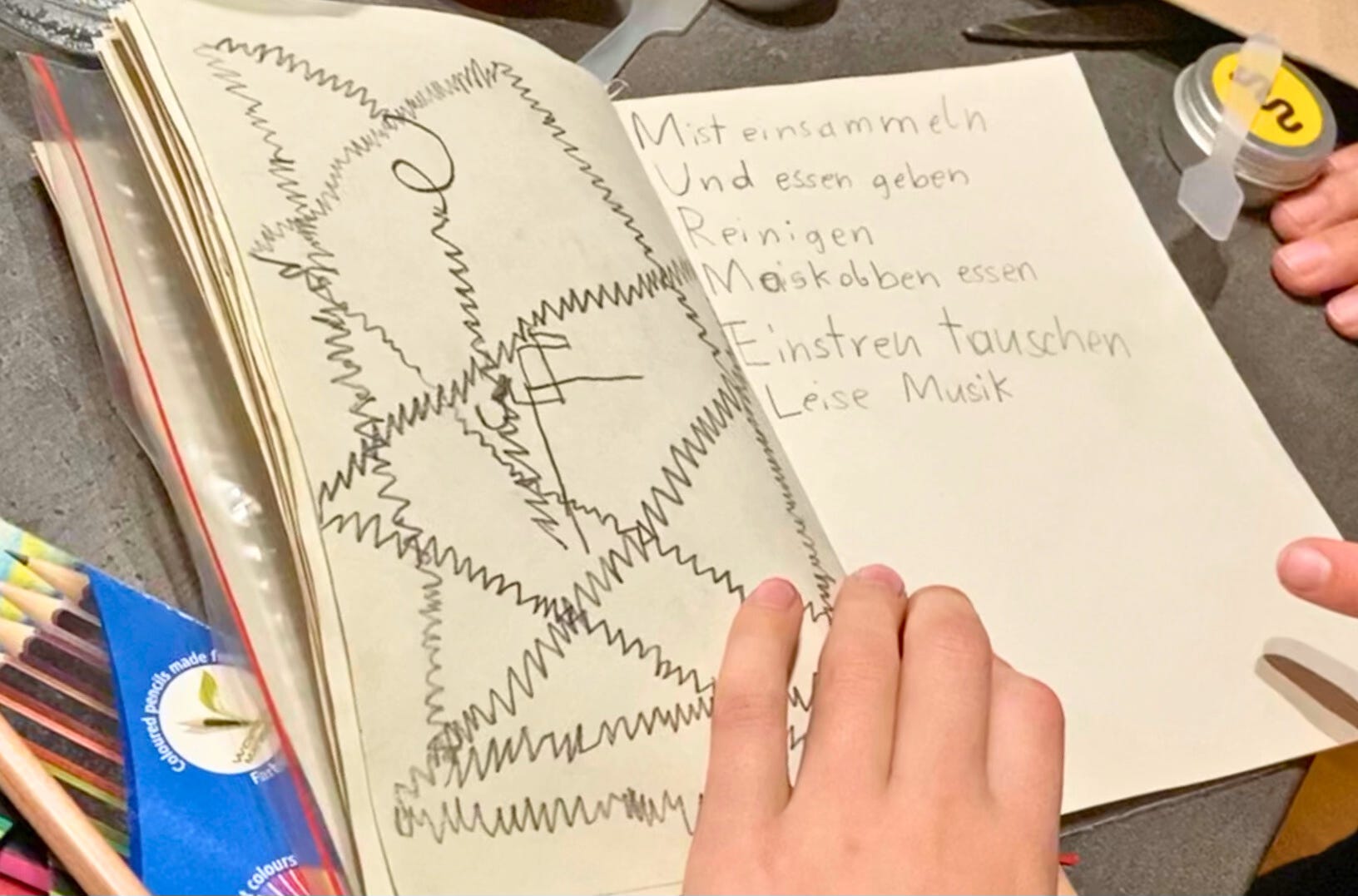
I am under no illusion how fleeting the effects of one workshop are. If not practiced regularly, the open-minded attention, wonder and creativity that come naturally to all people when they are young and that the workshop brought to the fore will make way for more rigid and unimaginative habits of feeling, thinking and acting in multispecies communities. And yet I really liked how — hands off, pen on, immobilised on the ground — the kids started wondering about what an animal really does and means.
Not just children can be quick to translate for “their” animals. Most pet owners or companion animal guardians will do it. I do it, too. It comes from a place of love and care. And yet we can also end up talking over the non-human animals, with the dog, cat, horse … whoever … becoming a mouthpiece for what the human would like (them) to say. Advocating for an animal you know well is one thing. But “Oh, you don’t like this horrible man, do you, Fido!” is a string of words that has little to do with the other animal, whether Fido is fearful or not. “He only wants to play” is more often than not an at least incomplete translation of what is on another animal’s mind, whether terrier or seal pup. Using creative techniques to take a step back, disrupt such anthropomorphic ventriloquy and truly wonder what another animal means, even one we believe we know very well, can be revelatory — or mystifying. Or both.
And that is the beauty of engaging in seemingly non-sensical writing exercises. The kids loved them just because, and so does my inner child. My adult self happens to believe that such humble exercises can teach us to become curious about more-than-human meaning-making and languages and attentive to the moments when it is actually humans who are adding, or at any rate decisively shaping, the significance.1
Many Points
I have an unusually vivid childhood memory of my own: I am six or seven years old and have placed myself in front of the garage at my parents’ place, right where the ants pass by. A collection of green leaves and red plastic broom bristles is by my side. Methodically, I push the bristles into the mossy cracks between the paving stones and stack leaves on top of the bristles with about half a centimetre space between them. I am building a high rise for the ants! What else? Makes total sense.
The ants had their own views about my offering. Some considered it a nuisance and just shuffled to get around all the crap I had put in their way. Others were more obliging (or opportunistic) and started pulling at some of the leaves or took off-cuts of my construction project to make better use of the material somewhere else. Not one ant looked as if she considered moving in. I clearly meant well, but my actions were nonsensical to the ants.
I know. I have been using concepts like ‘sense’, ‘meaning’ and ‘significance’ in a fashion that will make many a philosopher’s hair stand on end. (Whether such piloerection would be a sign of intellectual excitement or outrage, I don’t know, probably depends on the philosopher.) I apologise, but I have always lived with a strong feeling that philosophers of language are too focussed on human language. Perhaps pragmatists like Peirce who had a view of nature being shot through with sign relations would be more accommodating. And perhaps developments in biosemiotics are more promising than conservative Peirceans would allow for, some of whom quipped that Peirce’s (rather complicated) sign theory was ultimately taken up by the wrong crowd.
Be that as it may, today, we are in the wonderful position that, if only outside of philosophy, it is widely accepted that there are more-than-human languages. Sure, we are still worlds (or Umwelten) away from fluent two-way-communication, and dog knows if humans successfully mastering the Doolittle Challenge will actually behave better vis-à-vis other beings. (Near-perfect mastery of two-way-communication between humans does not give much reason for hope but perhaps we should start incentivising good linguistic behaviour among humans: a prize for most noble conversations.)
It would be nice to be able to converse with all sorts of beings, but let’s not forget that we have long established that being able to speak is not a necessary precondition for deserving moral concern. What is more, moral claims are complex. The fact that a competent speaker of a language you just happen to speak can tell you a long and moving story about how happy they would be if they would be granted a wish generates no special obligation for you to grant that wish if doing so would make another linguistically less competent being suffer. Even if your own child would like to keep a seal pup found on a beach as a pet and convincingly promises eternal happiness if only you allow it, that mustn’t happen.
Complicating all this, the perspectives of different non-linguistic beings carry different weights regardless of their species membership. I have a special obligation for my own dogs, even though I somehow “care for” all dogs on the planet. Above and beyond securing Norman’s general well-being, I should pay attention to his unique personality and what gives him meaning in life and if that means paying attention to things at which I would have turned my nose up, I should. On the other hand, just because my own dogs would be the happiest if they were allowed to hunt other animals, that doesn’t mean that they just may.2 Competing moral claims sometimes share a root or are neatly folded into each other as are leaves of a rose. Many claims humanity’s “best friends” make on us are rooted in and wrapped up with practices that harm other beings.
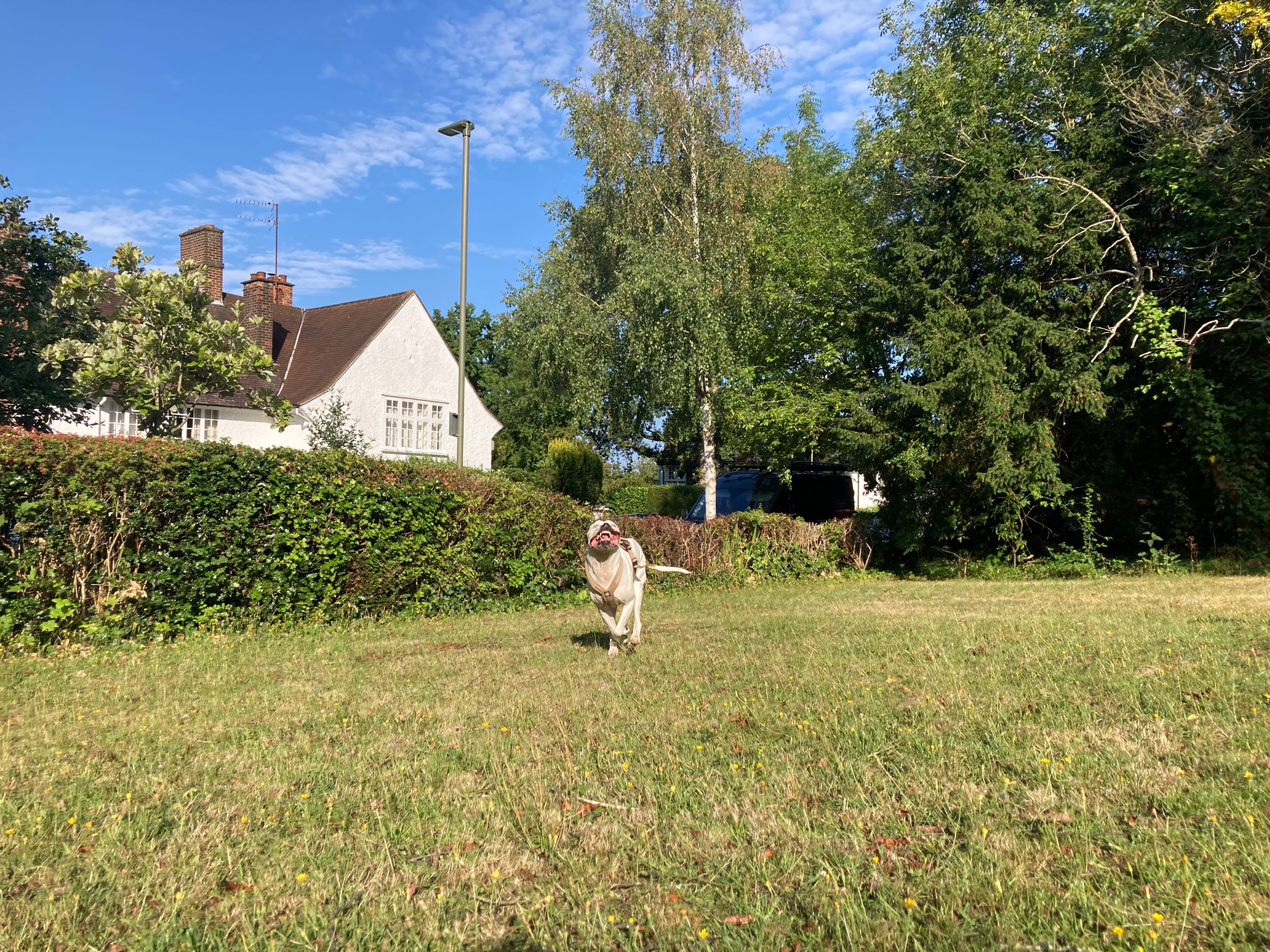
But what now with Norman’s re-creative behaviour that I celebrate in “No, I’m in the summer”? The resident ants are 100% disturbed. I truly don’t know how many other beings are uprooted once he gets going. Is it just nonsensical on my part to worry about what my dog does to a site which is regularly frequented by many other creatures going wild, some of which are human (going by telltale signs nearby)? I know I must not let him disturb a site if it has a sign saying “nature protection area” or some such nearby. Though what and when humans clearly signpost in "nature” is anything but straightforward. And anyway, Norman’s favourite sniff spot has no such sign! It is a tiny, neglected urban park. But who says the beings that live there do not matter? Perhaps nature itself has a way of telling me “protect me” after all. How could I know?
Turning into a rose
Experimenting with more-than-human language in an attempt to understand “nature” is not a childish concern anymore. Many poets and perhaps even more scientists are actively engaged in it. That is great. Any circle is made up of many points which are in turn made of circles … and points … adding new aspects and dimensions, blossoming into a rose.
As it happens, that is a rather thorny rose. Really handling the complexity of moral claims in what tends to be called animal and environmental ethics is as honorable and intriguing as it is difficult and frustrating.
We have good reasons to look for aspects we are missing. But we need to be clear about those reasons which, arguably, differ for different aspects. Some we need to take seriously because they result from perspectives that intentionally articulate claims that we can understand and ought to respect in their own right. Some we need to take seriously because they “tell us something” but the import is decided on our terms. And some will be in between. If we can only get this right, there is hope that we will become more just and less self-serving in our dealings with the more-than-human.
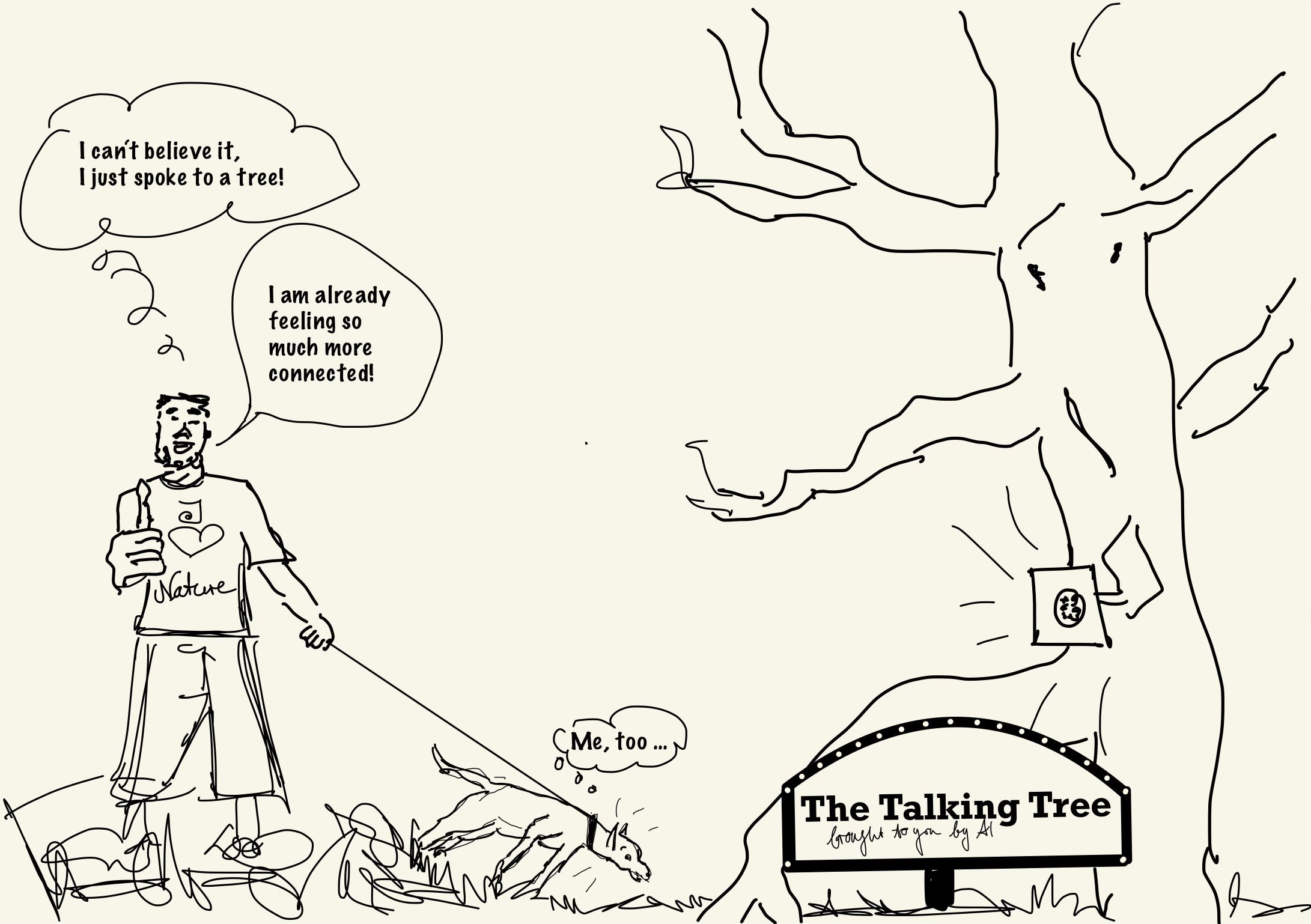
Hope. Now, the global philosophy and poetry project I am currently involved with, “Philosophy in the Wild. Finding Hope in Mixed Communities”, assumes that there are (at least) three types of relations between humans and wild living animals that give reason for such hope. The first two types are mutualistic relations and reparative relations; more on these types in the New Year. The third type is what I call futuristic relations. These are creative and speculative attempts to use what has worked in the case of intraspecific, human-human relations to improve human-animal relations. We know that sports can work wonders in getting destructive folks off the streets. So, why don’t we build keas a gym? Money is perhaps more of a double-edged sword and yet, there are people who think providing gorillas with credit cards is a good idea. We haven’t been able to send our anthrozoological vasculum to these two sites to investigate whether these ideas make sense in practice. But we found two futuristic innovations of human-animal relations in the political realm. Let me talk about one.
There is good reason to believe that democracy is an idea that has worked to improve human communities. Many thinkers in the political turn in animal ethics have spent a lot of time thinking about representing and including other animals in democracies, but as of today, there are no political systems that really experiment with these ideas in practice. Experiments are more small-scale. Like De Ceuvel, the ‘zoöp’ we looked at in Amsterdam.
‘Zoöps’ try to make democracy work for all life. That sounds nice and yet entails a complication. All life means non-animal and non-sentient life as well. In theory, there is no reason to exclude plants and fungi from moral consideration if we can understand their claims. The approach behind the ‘zoöp’ is to be open to that possibility and experiment with different attempts of mapping a given site, translating concerns and developing an innovative organisational practice.
Some elements of that practice can’t hurt anybody: transitioning away from fossil fuels, offering plant-based food. Yet ideas of restoration and co-creation always invite questions: Whose perspective, whose sense of time and space, whose needs and yearnings are going to be decisive in the process? How do you negotiate with a lichen or is wondering how to go about that already “one thought too many”?
The poetry that is supposed to come out of that place is instructive. Perhaps this is so nonsensical that it mocks the very idea of poetry. But then, what ideas of poetry are going to survive in the future?
We don’t have a poet on site that does the conventional spiel of translating from “the book of nature” into some kind of text. What we ended up doing, for now: We took two pages out of Mary Midgley’s Animals and Why They Matter (p. 90-91) that I have read and annotated many times, on social and ecological claims, and superimposed the double page with a monotype by a resident artist, Fabian Schäfer. This virtual erasure of philosophical thought by lichen imprint singled out a number of words, which I re-arranged in handwriting around it. Unsatisfied with the result, and in the spirt of futurism, I thought I should just feed the individual letters to an AI and ask for a poem in return. That conversation brought up issues about which human language would be appropriate for that site and for representing “all life” in the first place.


Perhaps not bad, but the poems spat out by AI are testament to a sentimental conception of poetry that claims that all, eventually, “echo the same song”.
The problems brought up by the zoöp-poem are not one of creative practice alone, but also of philosophical discussions around ‘agency’ as they are being cheered on by new materialism. I understand that there are chemical agents, but they are doing other things than, say a chemist. And surely a dog who can detect toxins is doing something closer to what the chemist is doing than to chemical agency itself.
The presence or absence of lichen might mean or “tell me” that an ecosystem has been on a particular ecological trajectory but it is not that the lichen means to communicate this in the same way that a wildlife detection dog means to communicate the presence of a fungus or bark beetle to her handler. More-than-human meaning can also veer between natural and conventional meaning in its own right. Social play behaviours are a testament to that.
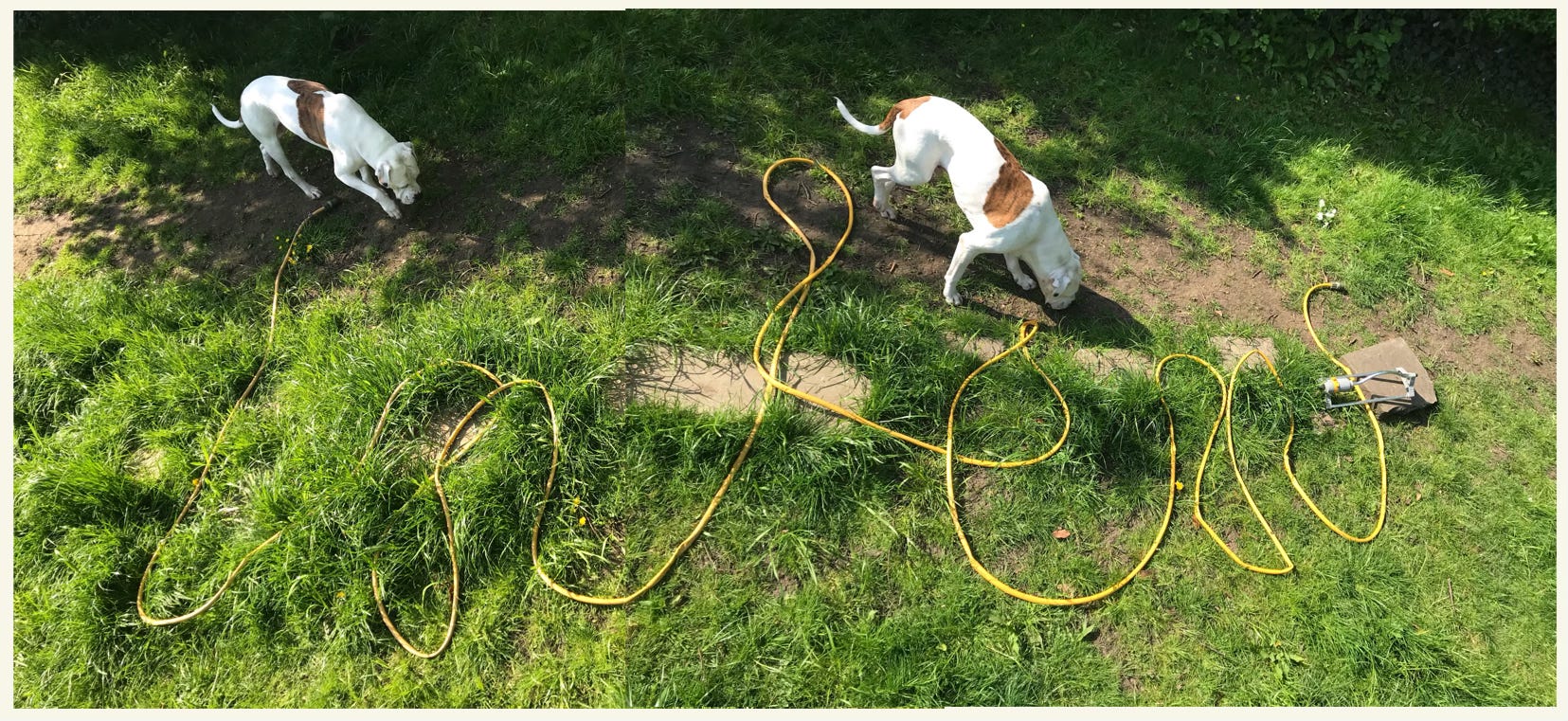
Finally, is there not a fundamental difference between the colours of a ripening fruit “telling me” that it is time to harvest (honourably, of course) and the contours of a pig filling in, perhaps “suggesting to some” that it is time for slaughter?
Call me old-fashioned or conservative, but for me, that difference is real and it lies in the perspective articulated by a sentient social being that expects something significant from life and we can organise meeting or frustrating such expectations within our communities. Language used for life is always also political. We see it in the artificial segregation of humans and other animals, when, say, “a bitch throws a litter” whereas “a woman gives birth to a child”. Something similarly suspicious is going on when different lifeforms with different perspectives are subsumed under homogenising frameworks. A new aesthetics that is philosophically awake and unwilling to gloss over real moral issues is important to counter this trend because aesthetic judgements are both contingent and deeply meaningful, veering on the religious.
I seem to remember but can’t find a passage in which William James talks about aesthetics and the difference of perspectives. James, or someone whom for the sake of the argument I will just call James, tells of a trip to the countryside where he gazes across a freshly tilled field and the uplifting beauty he finds in the geometry of the lines. But, he says, the person who has worked the field might find little uplifting in this perspective. Perhaps pleased, but tired, they watch it anxiously and hope for the soil to produce a harvest to sell. Someone walking past a tilled field today might think of all the carbon released in the process of doing so, perhaps the mice disrupted or exposed to birds of prey.
We should never underestimate the role of aesthetics in our judgments and seek for greater control over how linguistic culture habituates us to interpret the world. Being able to “read in the book of nature” is an idea appealing to a poetic attitude in many humans: you don’t have to be a poet to anthropomorphize and to play with meaning-making outside of the trodden paths of human linguistic communities. Allowing more for nonsense and uncertainty can, I believe, make us both more inventive and more accommodating, while staying real and, well, decisive for those in need.
To Make a Point
I feel we are currently trying to capture truly significant things — phenomena, beings, concerns — with words or concepts we already now. And yet these things, once looped into these concepts, keep bucking and kicking against being fixated like that. Many dogs are not ‘pets’. I don’t like being called my dogs’ ‘mum’ nor sold a ‘puppuccino’. Sure, perhaps these are just loose ways of playful speech in a culture besotted with companion animals. However, I also don’t know what an individual right would do for a tree and the ‘democracy of all species’ is meaningless to me. At a time when human rights and democracies alike are endangered, this bothers me as a philosopher.
As a poet, I am bored. Do we need new words?
Perhaps we need an altogether new way with language. We seem to have gotten things the wrong way around if we are asking, one by one, whether a being has language, feelings, uses tools and so on. Perhaps human language is actually nothing more than one tool among many, and, as things stand, it is not serving us very well in co-creating meaningful communities with significant others. But who knows, the longer we play with this, perhaps we can evolve some sense to detect actually dangerous nonsense from three miles against a stiff breeze.
Just an etymological aside: Did you know that de-cide literally comes from ‘to cut something off’, even ‘strike down’ or ‘kill’ something?
If you read German, you can find a “diary with many voices” on the topic of hunting in which I try to converse with my dogs and other hunters in prose in the new issue of TIERSTUDIEN.
Beautiful reflections. Thank you for sharing them with us, dear Mara.